
As a founder, sometimes you attend events where you don't know what to expect.
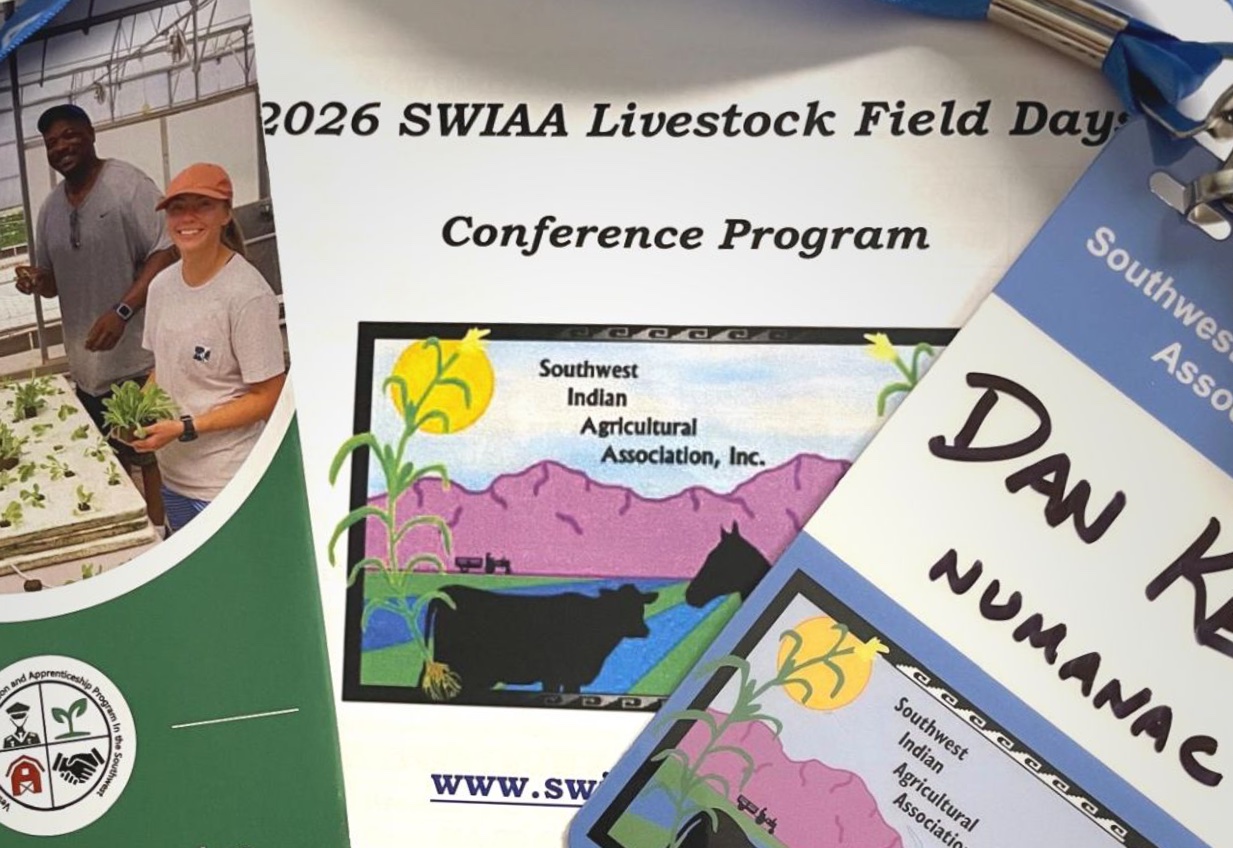
I was asked to attend the Southwest Indian Agricultural Association's field days to bring an "AI in Ag" perspective. I found myself mostly listening and asking questions. It turned out to be the right way to spend the time.
The field days
The Southwest Indian Agricultural Association (SWIAA) has spent decades promoting the conservation, development, and use of Native American agricultural resources in the Southwest. It has organized more than 36 annual conferences toward that goal, bringing together tribal farmers and ranchers, Extension agents, and specialists (source).
I was there at the invitation of the University of Arizona's Tribal Extension program, which supports Native American communities through agricultural education and outreach (source). Its agents are part of the federal Federally Recognized Tribes Extension Program (FRTEP), and there are very few of them nationally. As of 2023, 35 FRTEP agents served 32 of the 574 federally recognized tribes (EESI).
What we heard
Tribal growers were candid about facing nearly every challenge in agriculture, all at once and with significantly limited resources.
I won't try to speak for them here. Those are their stories to tell. My job that day was to listen.
Four generations
It was the most multi-generational event I have attended. Several families had four generations present.
Four generations in one place puts a different time horizon on every conversation.
It was a welcome chance to slow down and just listen. That is increasingly rare in a startup world where everything moves incredibly fast.
One word: fair
Despite all the talk of speed and scale, the day was a reminder of the question we can never forget: how do we build something that makes agriculture more, in one word, fair?
For us, that starts with access. Tools have to work where the work happens, for operations of every size, and they have to be built with the people who use them. It is part of why we partnered with Extension Foundation to bring Land-Grant research into Numanac.
Thanks
I appreciated the invitation from the University of Arizona's Tribal Extension program to showcase Numanac as we build accessible tools for communities such as SWIAA.
A shoutout as well to the University of Arizona College of Agriculture, Life and Environmental Sciences and the Yuma Center of Excellence for Desert Agriculture. Founded in 2014, the Yuma Center brings researchers, industry, and government together to deliver fast, practical answers for desert crop production (ASU). It is clear their belief in serving communities by taking on severe agricultural challenges is driving some incredible results.
FAQ
What is the Southwest Indian Agricultural Association?
SWIAA is an organization that promotes the conservation, development, and use of Native American agricultural resources in the Southwest. It has organized more than 36 annual conferences for tribal farmers, ranchers, and Extension professionals.
What is the Federally Recognized Tribes Extension Program?
FRTEP is a federal program, created under the 1990 Farm Bill and administered by USDA's National Institute of Food and Agriculture, that funds Extension agents serving tribal communities. The University of Arizona's Tribal Extension agents are part of it.
Why was Numanac at SWIAA field days?
The University of Arizona's Tribal Extension program invited Numanac to bring an AI in agriculture perspective and to show the tools we are building.
What is Numanac?
Numanac is a voice-first platform for capturing agricultural field context. It turns what agronomists, growers, and field crews say into structured records, reports, and recommendations.