
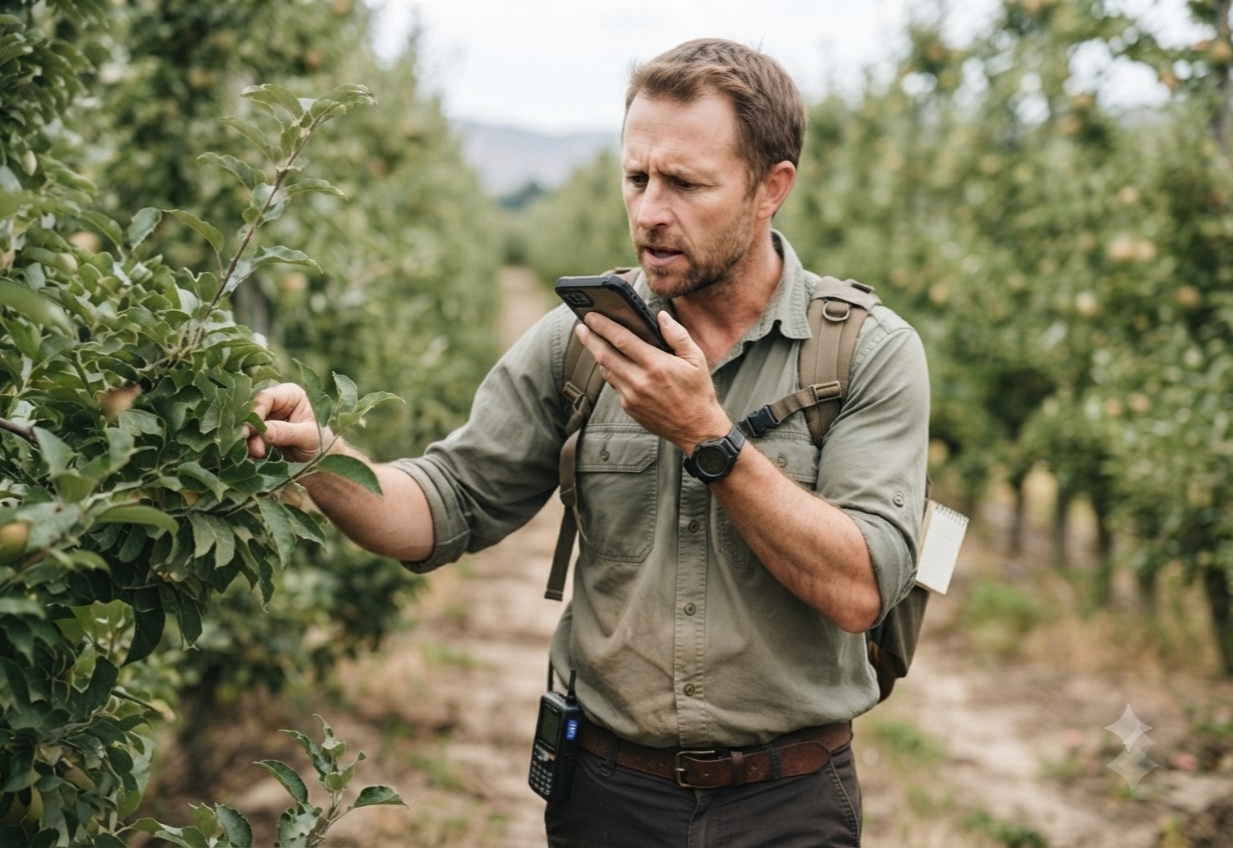
We read thousands of scouting notes captured through Numanac, our voice-first farm management platform, walked block by block through fields and orchards. Scouts report levels, changes, places, causes, and populations, usually all five at once, and most of that never survives contact with a form that simply ingests values.
Five things scouts say that forms cannot hold:
Levels. "Rust light to moderate, more on the north side." A form wants a number; the scout gives a range, a location, a proportion.
Deltas. "Rust and leaf spot unchanged from last week." The scout is reporting a change against a reference in their head.
Sub-block space. "Mites on the south edge, nothing inside the block." The schema stops at the block boundaries.
Causal asides. "Road very dusty, watch the edge for mites." No form has a field for "why I think this is happening."
Ecology. "Predatory mites present, mostly dead, a few still alive." Whether to spray depends on exactly this, and a checkbox marked "mites: yes" throws it away.
| The scout said (paraphrased) | What it carries |
|---|---|
| "Rust light to moderate, more on the north side" | a level, a range, and a place |
| "Leaf spot unchanged from last week" | a delta against a reference the system has to hold |
| "Mites on the south edge, nothing inside the block" | sub-block space |
| "Road very dusty, watch the edge for mites" | a causal aside |
| "Mites mostly dead, predatory mites present" | a population, with predators |
Forty seconds of speech. A form would keep two of the five.
The delta problem
"Unchanged from last week" only means something if the system knows what last week was. Force a scout onto an absolute scale and they either invent a slightly different number each week for the same condition, or pick the same number every week and flatten a season that wasn't flat.
Numanac's weekly digest carries the reference forward: "held steady" becomes "held steady from last week," in the scout's own frame, while an absolute like "moderate" still gets kept. The failure mode is a system that only accepts absolutes.
| Form field | What the scout said | What the form keeps |
|---|---|---|
| Pest present (yes/no) | "Light mites on the south edge, mostly dead, no webbing inside" | Yes |
| Severity (1 to 5) | "Light to moderate, worse on the north side" | 2, or 3 |
| Location | "Block 4, south edge" | Block 4 |
| Trend | "Unchanged from last week" | no field |
| Cause | "Dust off the road" | no field |
| Beneficials | "Predatory mites present" | rarely a field |
From notes to a weekly digest
A manager with six orchards doesn't want to read four hundred notes. They want to know which orchard needs attention this week, and why. Numanac's activity digests wrap up each orchard's status:
ACTIVITY REPORT   Orchard D   Week 3   Status: NEEDS ATTENTION

Rust holding across the orchard and higher in Blocks 1 and 2. Mites on edges
in three blocks with no flare-ups. Water stress recurring in Block 4.

PEST, DISEASE AND WEEDS
  Rust moderate orchard-wide, above moderate on the north side   Blocks 1, 2
  Leaf spot unchanged from last week                             all blocks
  Spider mites on south edges, no flare-ups; predatory
  mites present in Block 5                                       Blocks 2, 3, 5
  Weeds light; tree rows mostly clean; grass at the replants     Block 6

APPLICATIONS
  Block sprayed overnight; product and target not recorded       Block 3

IRRIGATION AND WATER
  Water stress on some trees, second week running                Block 4

OPEN ITEMS AND DECISIONS
  Monitor rust in Blocks 1 and 2
  Follow up on water stress in Block 4
  Record product and rate for the Block 3 application

Signature ____________   Date ________   By ________
What the digest is for
Forwardable as-is. Printable and signable, so a generated summary becomes a record the operation stands behind. It reads like the memo a manager would have written anyway. The scouts already do the hard part. Numanac's job is to summarize, analyze, and never lose your carefully collected data.
Examples in this piece are paraphrased from real notes.